|
Group Method of Data Handling was applied in a great variety of areas for deep learning and knowledge discovery, forecasting and data mining, optimization and pattern recognition.
Inductive GMDH algorithms give possibility to find automatically interrelations in data, to select an optimal structure of model or network and to increase the accuracy of existing algorithms.
This original self-organizing approach is different from deductive methods used for modeling. It has inductive nature - it finds the best solution by sorting-out of possible variants.
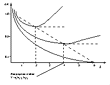 By sorting of different solutions GMDH networks aims to minimize the influence of the author on the results of modeling. Computer itself finds the structure of the optimal model or laws that act in a system.
Group Method of Data Handling is a set of several algorithms for different problems solution. It consists of parametric, clusterization, analogues complexing, rebinarization and probability algorithms.
This inductive approach is based on sorting-out of gradually complicated models and selection of the optimal solution by minimum of external criterion characteristic. Not only polynomials but also non-linear, probabilistic functions or clusterizations are used as basic models.
GMDH approach can be useful because:
- Optimal complexity of the model structure is found, adequate to the level of noise in data sample. For real problems, with noised or short data, a simplified optimal models are more accurate.
- The number of layers and neurons in hidden layers, model structure and other optimal hyperparameters are determined automatically.
- It guarantees that the most accurate or unbiased models will be found - method doesn't miss the best solution during sorting of all variants (in the given class of functions).
- As input variables can be used non-linear functions or features, that may have influence on output variable.
- It automatically finds interpretable relationships in data and selects effective input variables.
- GMDH sorting algorithms are rather simple for software development.
- Twice-multilayered neural nets can be used to increase the accuracy of another modelling algorithms.
- Method get information directly from data sample and minimizes influence of apriori author assumptions about results of modeling.
- Approach gives possibility to find objective physical model of object (law or segmentation) - the same on future samples.
It was implemented in the many commercial software tools.
Also GMDH is known as well as Polynomial Neural Networks, Abductive and Statistical Learning Networks.
|